Articles in this Volume

Research Article Open Access
The abolition of Doli Incapaxand its partial compatibility with juvenile justice in England and Wales
This essay examines whether the abolition of Doli Incapax in England and Wales is compatible with the developmental logic of juvenile justice. Before 1998, Doli Incapax functioned as a legal safeguard and required the prosecution to prove that a child aged between ten and fourteen understood that their actions were seriously wrong, rather than only naughty. This reflected a developmental approach that recognised children's limited cognitive capacity. The essay argues that the abolition of the doctrine in 1998 marked a significant shift towards a more punitive, simplified system, in which criminal responsibility is determined primarily by age rather than individual understanding. By analysing legal cases, academic commentary, and policy debates, the essay demonstrates that this change was influenced by political pressure and societal concerns about youth crime rather than developments in child psychology. The findings suggest that the current system risks holding children criminally responsible at an age when their decision-making abilities are still developing. While procedural safeguards and sentencing adjustments remain, they do not fully compensate for the loss of a substantive defense such as Doli Incapax. Overall, the essay concludes that the abolition is only partially compatible with the developmental principles of juvenile justice and raises important questions about fairness, responsibility, and the purpose of the youth justice system.
Show more
Read Article PDF
Cite
Research Article Open Access
Optimization strategies for the linguistic landscape of harmonious and beautiful rural areas in Henan Province: top-level design, categorized optimization, typical case plans, and safeguard mechanisms
Article thumbnail
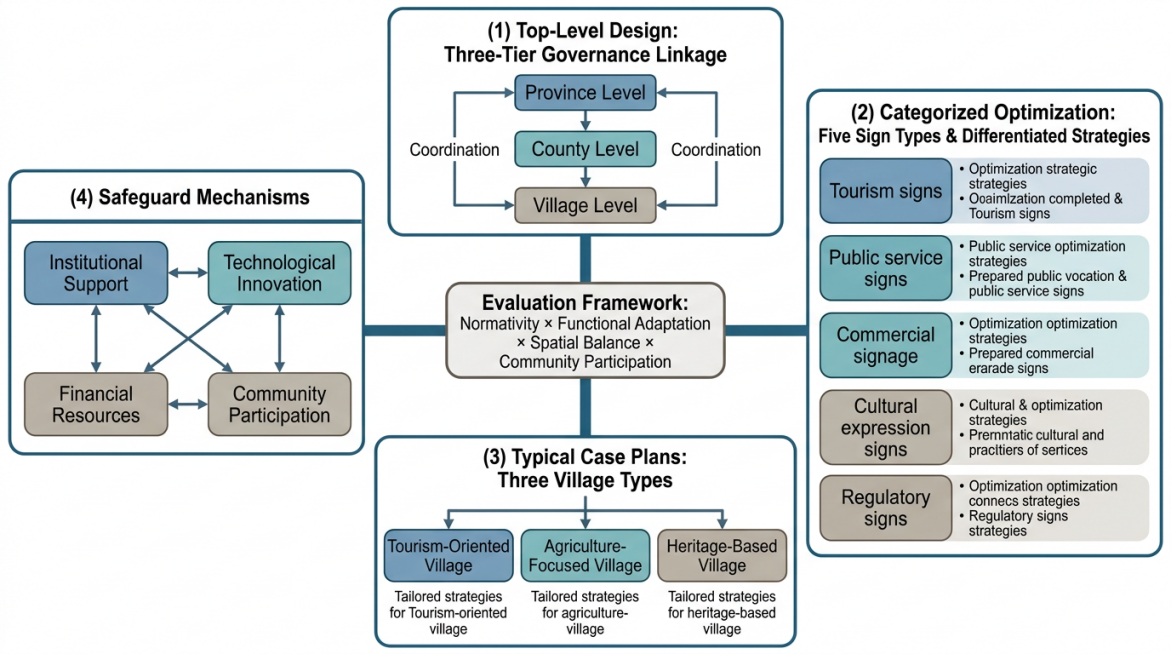
The linguistic landscape (LL) paradigm, traditionally grounded in urban public-space analysis, has increasingly been extended to rural contexts as China advances from the "Beautiful Countryside" initiative to the "Harmonious and Beautiful Countryside" (和美乡村) policy framework. This survey proposes a "normativity×functional adaptation×spatial balance×community participation" four-dimensional evaluation framework, benchmarked against the Landry and Bourhis information/symbolic-function distinction, and applies it to the rural linguistic landscape of Henan Province. Through a systematic review of the literature from 2018 to 2026, we construct a four-pillar strategy system encompassing top-level design, categorized optimization by sign type, typical village case plans, and multi-dimensional safeguard mechanisms. The categorized optimization pillar proposes differentiated strategies for five sign types, shifting the operational logic from standardized deployment to differentiated empowerment. The case-study pillar reveals a contrastive gradient of optimization priorities across tourism-driven, agriculture-dominated, and culture-heritage villages. The survey identifies three critical research gaps: the absence of rural-specific LL evaluation indicators, the scarcity of large-scale quantitative and longitudinal evidence, and the unclear integration of digital technology with community participation.
Show more
Read Article PDF
Cite
Research Article Open Access
Practical dilemmas and improvement proposals for the personal bankruptcy discharge system
In recent years, China has launched pilot programs for the personal bankruptcy system in cities such as Shenzhen, Wenzhou, and Xiamen. This institutional innovation not only offers a fresh start to "honest but unfortunate" debtors, but also plays a significant role in addressing difficulties in enforcement and maintaining social and economic stability. Taking Shenzhen as an example, current pilot practice still faces several problems, including ambiguous standards for determining "honesty," insufficient flexibility in the discharge observation period, disputes over the legal effect of discharge, and inadequate protection of creditors' rights. To address these issues, it is necessary to formulate a list of non-dischargeable circumstances and introduce a fault-based allocation mechanism to refine the criteria for determining honesty; establish a flexible observation period to increase the adaptability of discharge conditions; clarify the legal effect of discharge; and strengthen creditors' procedural rights protection, thereby promoting the sound development of the personal bankruptcy discharge system.
Show more
Read Article PDF
Cite
Research Article Open Access
Paradigm shift, path innovation, and institutional guarantee in the construction of humanities and social science laboratories in universities
Against the backdrop of higher education reform and development during the 15th Five-Year Plan period, humanities laboratories specializing in ecological civilization and environmental governance are shifting from "instrumental platforms" to "innovative carriers." Taking provincial-level humanities laboratories as research objects, this paper analyzes the problems existing in their paradigm shift, path innovation and institutional guarantee, and identifies three core tensions: the cognitive tension between disciplinary logic and problem-oriented logic, the value tension between technological empowerment and humanistic persistence, and the institutional tension between short-term performance and long-term accumulation. The key to resolving these tensions lies in realizing a paradigm leap from "instrument-based" configuration to "institution-based" innovation, and further to "culture-based" ecology. Accordingly, the construction of laboratories should adhere to the orientation of "interdisciplinary integration, data-driven research, virtual-real integration and open sharing." By refining top-level design, innovating operational mechanisms, reforming evaluation systems and reinforcing conditional support, we can drive laboratories to evolve from "physical spaces" to "meaningful spaces" and from "experimental platforms" to "ecological spaces," so as to provide support for constructing an independent knowledge system of Chinese philosophy and social sciences.
Show more
Read Article PDF
Cite
Research Article Open Access
Memory services in the aging economy: a review of market trends
With the accelerating global aging population, the prevalence of cognitive impairments, particularly Alzheimer's disease and related dementias, is rising steadily, giving rise to a substantial and rapidly expanding market for memory services. This review aims to systematically examine the core development trends, driving factors, innovative service models, and challenges within the memory services market in the context of the aging economy. It provides a comprehensive analysis of the entire industry chain, spanning early screening, diagnosis, non-pharmacological interventions, long-term care, and technological support. By integrating the latest business models, policy directions, and evolving consumer demands, this article explores future development trajectories and investment potential in the memory services sector. The insights offered herein are intended to support practitioners, policymakers, and researchers engaged in this critical field by delivering an in-depth understanding of current market dynamics and emerging opportunities.
Show more
Read Article PDF
Cite