Articles in this Volume

Research Article Open Access
On the judicial determination of "married-out women acquiring contracted land in their new place of residence"
An important controversial point in disputes over rural married-out women's land contractual management rights is the identification standard for "married-out women acquiring contracted land in their new place of residence". Among the three types of such disputes, conflicts arise among various parties due to differences in this identification standard. The reasons for the disputes lie in the traditional concept of "marry and follow the husband", the inconsistent content of village regulations and people's conventions, the failure of land contractual management right certificates to timely reflect changes in the relationship between people and land, and the need to clarify the evidential effect of the registration of land contractual management rights. To resolve these disputes, countermeasures should be taken from four aspects: when settling such disputes, priority should be given to determining whether the married-out woman has acquired contracted land in her new place of residence; "the married-out woman has not acquired contracted land in her new place of residence" should be recognized as an objective fact; the method for "married-out women to acquire contracted land in their new place of residence" must be more explicit; and this matter must be determined based on actual circumstances. Only in this way can the land rights and interests of rural women be better protected and the improvement of the land contracting system be promoted.
Show more
Read Article PDF
Cite
Research Article Open Access
The relational structure, value connotation, and practical strategies of frontier governance modernization: a case study of the Tibet Autonomous Region
As a crucial component of the broader national governance modernization agenda, the modernization of frontier governance holds substantial significance for safeguarding border security and ensuring lasting stability. The year 2025 marks the 60th anniversary of the founding of the Tibet Autonomous Region. Over these six decades, Tibet has undergone transformative changes and has developed a governance model of strategic value under the leadership of the Party. Drawing on Tibet’s development trajectory, this article analyzes frontier governance from the perspective of Party committee leadership. It argues that core leadership capacity should be strengthened through advancements in political, organizational, and ideological development. From the standpoint of government administration, emphasis must be placed on high-quality development, expanding foreign trade and regional influence, and pursuing a path of green and ecological governance. Together, these efforts will drive the modernization of frontier governance.
Show more
Read Article PDF
Cite
Research Article Open Access
The role and practices of German educational enterprises and their enlightments for the development of industry-education integrated enterprises in China
Article thumbnail
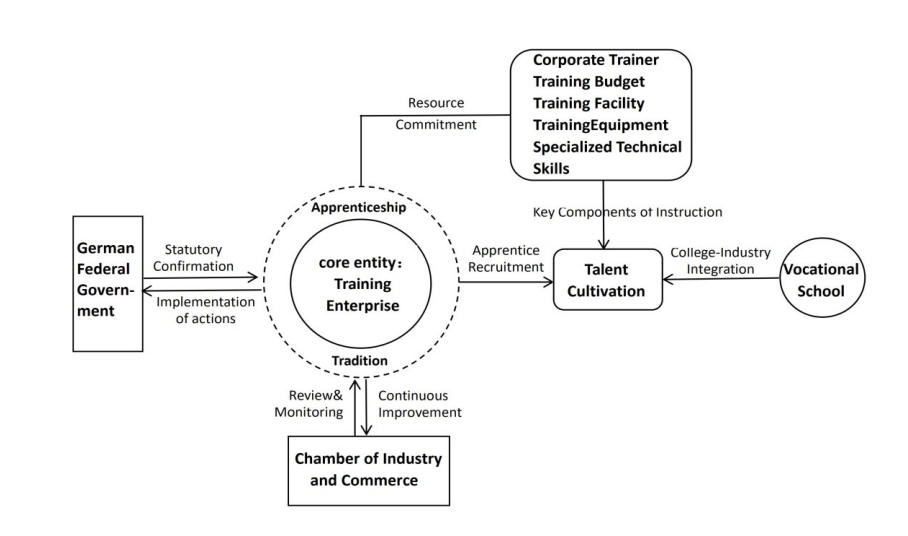
Industry–education integrated enterprises are among the key organizational forms and practical carriers through which China implements its industry–education integration strategy at the micro level. Their development outcomes directly reflect the degree to which policy objectives are being achieved and the effectiveness of their implementation. From an international perspective, German educational enterprises represent a paradigmatic model of deep engagement in vocational education. The historical and cultural legacy that shaped the evolution of these enterprises, together with the legal confirmation of their principal behaviors, firmly grounds the role positioning of core actors. By directly investing in comprehensive, unified, and high-quality industry–education resource elements, these enterprises effectively fulfill their principal responsibilities. At the same time, they form collaborative mechanisms with multiple stakeholders—including governments at various levels and industry associations—thereby enhancing the capacity and effectiveness of educational enterprise actors. Drawing on the practical experience of German educational enterprises, China’s development of industry–education integrated enterprises should focus on the following: establishing a sound institutional framework to clarify enterprises’ principal responsibilities; promoting unified allocation and increased direct investment of enterprise industry–education resources; strengthening the supervisory and guiding roles of vocational education program committees to safeguard the quality of talent cultivation; building precise incentive mechanisms that encourage enterprise participation; and enhancing value guidance related to social responsibility to deepen enterprises’ internalized recognition of their roles.
Show more
Read Article PDF
Cite
Research Article Open Access
A study on the international communication effect of Chinese Sci-Fi films and TV series based on LDA topic modeling: a case study of English reviews of the Chinese and American versions of The Three-Body Problem
Article thumbnail
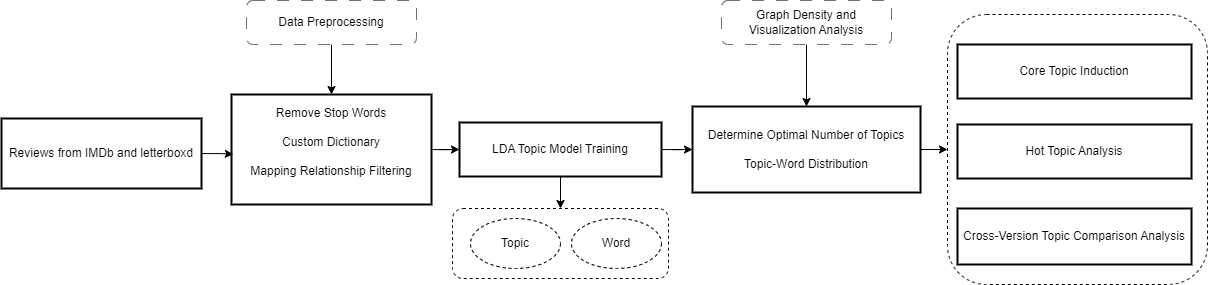
With Chinese science fiction films and TV series gradually entering the international stage, this study focuses on English-language reviews on IMDb and Letterboxd. Using Latent Dirichlet Allocation (LDA) topic modeling, it analyzes the international reception of the Chinese sci-fi work The Three-Body Problem, aiming to uncover the main discussion points and differences in attention among foreign audiences for the two versions of The Three-Body Problem through text-mining techniques. The findings reveal differences between the two versions in terms of target audience, cultural presentation, adaptation evaluation, and focus in plot discussion. Moreover, this study explores new pathways for Chinese sci-fi media to go global from four dimensions: channel, content, communicator, and recipient. The study provides not only a novel perspective for understanding the international influence of Chinese sci-fi media but also empirical support for strategies in the international dissemination of Chinese cultural products.
Show more
Read Article PDF
Cite
Research Article Open Access
How does online social capital influence health behaviours among older adults? — an analysis based on the mediating effect of health beliefs and structural equation modeling validation
Article thumbnail
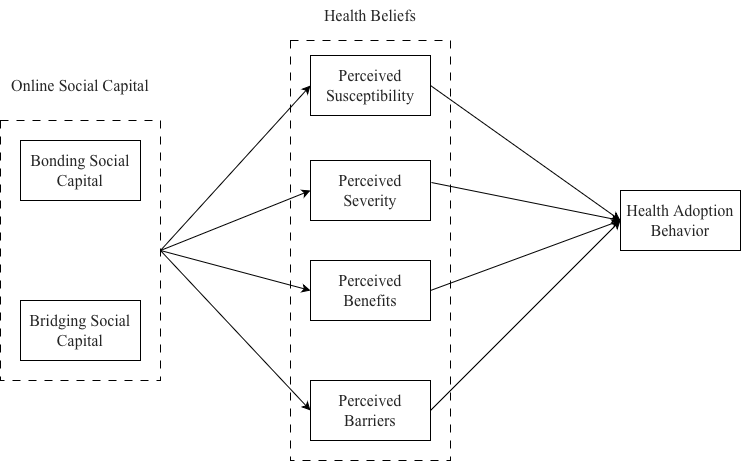
Against the backdrop of China’s deep aging population and widespread internet adoption, online channels have become an important avenue for optimizing health management among older adults. However, the persistent “digital divide” continues to limit the full realization of this potential. Existing studies often treat online social capital as a single overall variable and have not sufficiently examined the mediating role of health beliefs between two types of online social capital and older adults’ health behaviours, leaving the underlying mechanisms unclear. Based on 465 valid nationwide survey responses and grounded in Bandura’s Social Cognitive Theory, this paper analyzes the influence mechanisms of bonding and bridging online social capital and health beliefs (perceived susceptibility, severity, benefits, and barriers) on older adults’ health behaviours. The study finds that neither type of online social capital has a significant direct effect on health behaviours; all four dimensions of health beliefs positively influence health behaviours (with perceived severity having the strongest effect); perceived susceptibility, severity, and benefits serve as significant mediators, while perceived barriers do not. This paper reveals relevant mechanisms and provides references for digital health interventions and age-friendly platform design for older adults.
Show more
Read Article PDF
Cite
Research Article Open Access
Bridging the acceptance gap: insights from digital health tools among middle-aged and elderly chronic patients
Article thumbnail
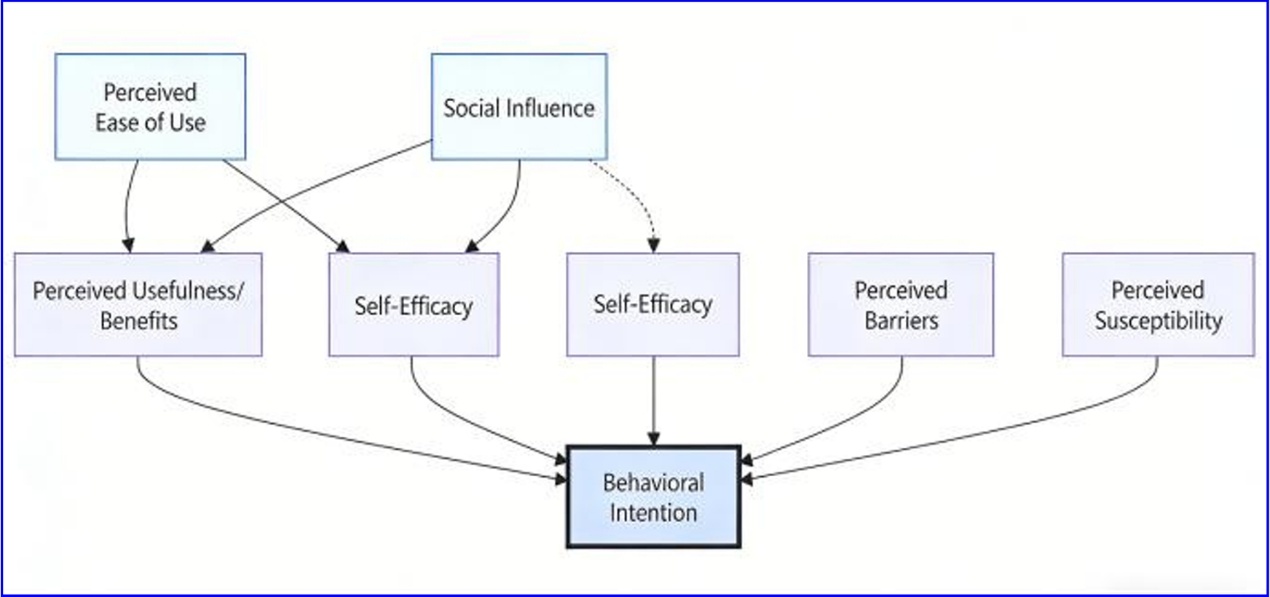
Digital health technologies exhibit substantial potential in the management of chronic conditions, yet their uptake among middle-aged and elderly patients continues to be notably sluggish, resulting in a prominent "acceptance gap." To unravel the psychological underpinnings of this phenomenon, this study integrates the Health Belief Model (HBM) and the Technology Acceptance Model (TAM) to construct a comprehensive analytical framework. A cross-sectional survey was conducted among 409 chronic disease patients aged 45 and above in an eastern Chinese city, and the proposed integrated model was validated using structural equation modeling. The results demonstrated a good model fit (χ²/df = 2.78, CFI = 0.93, RMSEA = 0.06). Specifically, perceived usefulness/benefits, perceived severity of disease, and self-efficacy emerged as significant positive predictors of behavioral intention, while perceived barriers exerted a marked negative influence. Social influence and perceived ease of use played crucial indirect roles by enhancing perceived usefulness/benefits and self-efficacy. Notably, the direct effect of perceived susceptibility on behavioral intention was not statistically significant. This study confirms the effectiveness of the integrated model in explaining usage intentions. To bridge the acceptance gap, multi-dimensional strategies are required: optimizing design to improve ease of use and enhance user self-efficacy, clearly conveying the core health values of digital tools in promotional efforts, and actively leveraging recommendations from healthcare professionals to drive adoption.
Show more
Read Article PDF
Cite
Research Article Open Access
Social information narratology: the integrated unity of information ontology and narrative practice
Based on an interdisciplinary integration of Wu Kun’s theory of social information and narratological theory, this paper constructs the emerging cross-disciplinary field of social information narratology. By revealing the ontological isomorphism between the three states of information (information-in-itself, information-for-itself, and regenerated information) and the three levels of narrative (story, discourse, and narration), the study demonstrates the deep-seated unity of the two theoretical systems at the levels of ontology, epistemology, and praxis. The findings indicate that the “unity of three qualities” of social information provides an ontological foundation for narrative practice, while the paradigmatic transformation of narratology directly responds to the historical demands of the philosophical revolution in information. Practical forms such as news narratology, Marxist philosophical narratology, and television media narratology substantiate the historical inevitability of this unity. Social information narratology not only reconstructs the theoretical framework of information communication but also reveals the essential laws governing the generative mechanism of “information–symbol–meaning,” thereby offering a new theoretical horizon for cultural production and social cognition in the digital age.
Show more
Read Article PDF
Cite
Research Article Open Access
On the labor narrative of Marx's thought on the human-nature relationship
The differentiation and antagonism between humanity and nature produced by capitalist civilization constitute the core of Marx’s thought on the relationship between humanity and nature. Through his critique of alienated labor, Marx identified private ownership as the social root of this division and opposition, and clarified that the realization of the “two reconciliations” must be grounded in the sublation of alienated labor. Marx further dissected the internal operating mechanisms of capitalist society and, taking wage labor as his point of entry, elucidated the general laws governing the material metabolism between humanity and nature. In doing so, he identified both the preconditions for the emergence of metabolic rifts between humanity and nature and the conditions under which such rifts may be repaired. Marx demonstrated the rationality of constructing an ideal vision of harmonious human–nature development on the basis of free labor. By following the laws of beauty, free labor enables an initial reconciliation between humanity and nature, transcends alienated and wage labor through the association of free individuals, and thereby propels human society from the realm of necessity toward the realm of freedom. Upholding Marx’s thought on the relationship between humanity and nature in the new era is conducive to advancing a new chapter in which labor creates harmonious coexistence between humanity and nature.
Show more
Read Article PDF
Cite
Research Article Open Access
Artificial intelligence empowering the construction of the China–Cambodia community of shared future: mechanisms and collaborative pathways
Article thumbnail
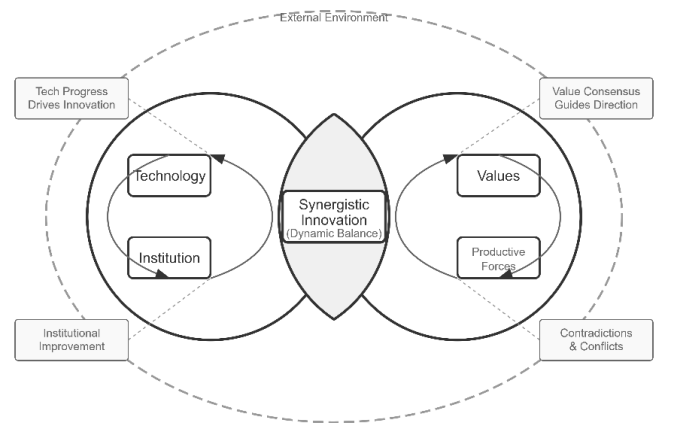
This study, grounded in a Marxist “technology–institution–value” three-dimensional analytical framework, examines the internal mechanisms and collaborative pathways through which artificial intelligence (AI) can empower the construction of a China–Cambodia community of shared future. The research finds that, although preliminary coordination exists between China and Cambodia in technological complementarity, institutional frameworks, and value alignment, several challenges persist. These include technological bottlenecks such as weak infrastructure, limited data resources, and a lack of innovation ecosystems; institutional barriers including misaligned laws and regulations, fragmented supervision, and difficulties in standard harmonization; as well as value-related gaps such as differences in cultural perceptions, fragile foundations of mutual trust, and insufficient social participation. To address these challenges, three strategic pathways—technological coordination, institutional alignment, and value consensus—are proposed to build a systematic solution structured around “foundational support–institutional guarantees–social integration.” This framework provides theoretical guidance for China–Cambodia AI cooperation and offers insights for innovating digital collaboration models within the Belt and Road Initiative.
Show more
Read Article PDF
Cite